

Day 17: When simple shapes are enough.
What pottery drawing taught me about seeing and letting simplicity do the work.

Hey, I’m Susan! I’m an artist, and I’m doing a 100-day sketchbook project: painting daily, and writing about it here. Sharing the ugly and pretty pages. If you enjoy it, I’d love if you share it.
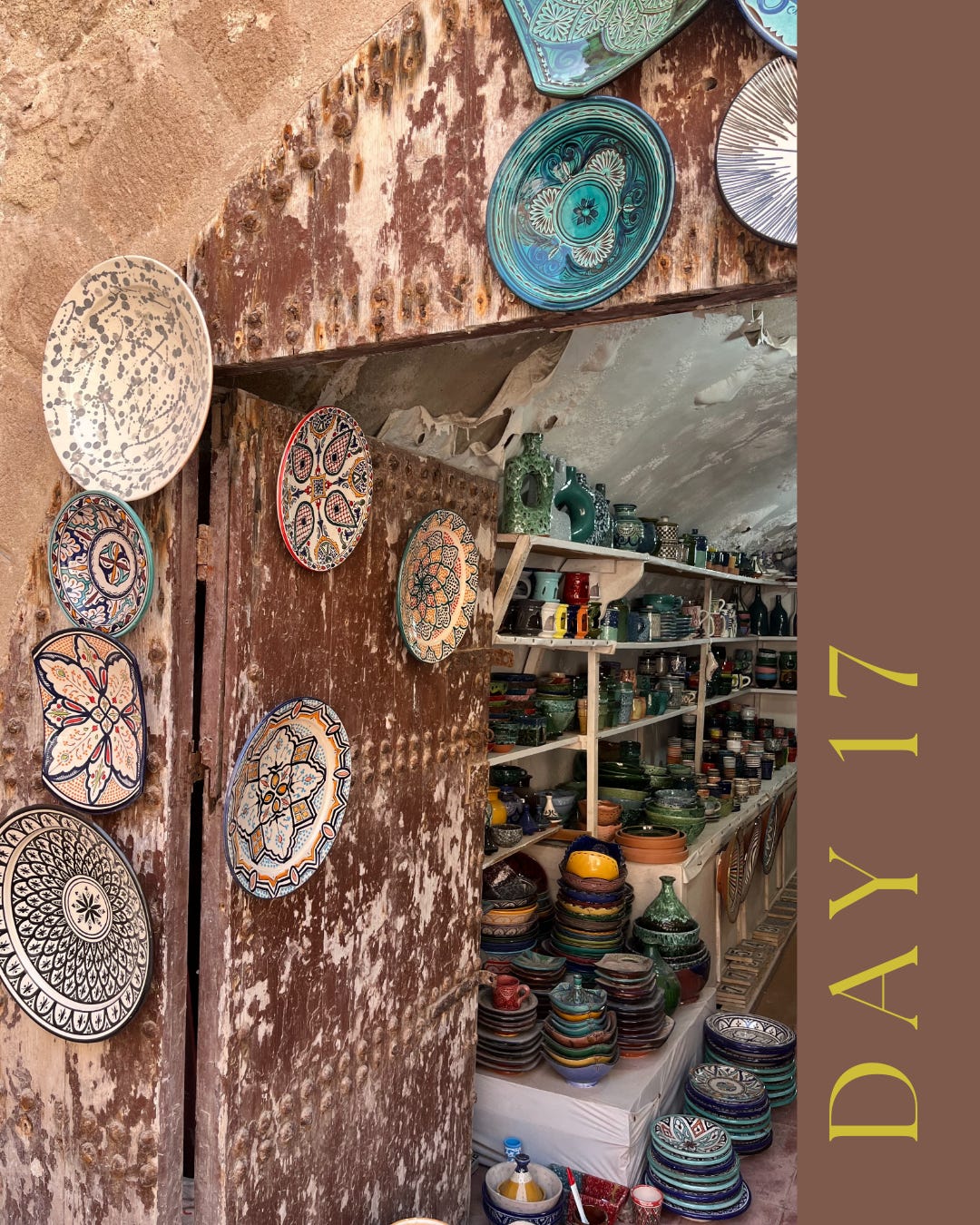
Artists can underestimate simplicity in art. Sometimes, the simple shapes are the ones that ask the most from you.
A bowl. A mug. A small pot. They seem easy at first glance.
If you’re familiar with them and have drawn them many times, they probably do become simple over time.
But that’s not the case for me. This is unfamiliar territory I’m exploring.
The longer you sit with them, the more you notice the details. One is tall, another is a slender vase. There’s a two-handled traditional vase, a large bowl, a timeless cup, and a unique shape you can’t even name
When you look closer, you don’t just see “a shape.” You see structure and form: cylinder, cone, sphere, and ellipse, all within those everyday objects.
It can start to feel demanding to get it “right,” never mind making both sides look perfectly, the same. That’s a whole other level of struggle. But as I’ve been drawing vases and pottery, it’s also where seeing begins to deepen.
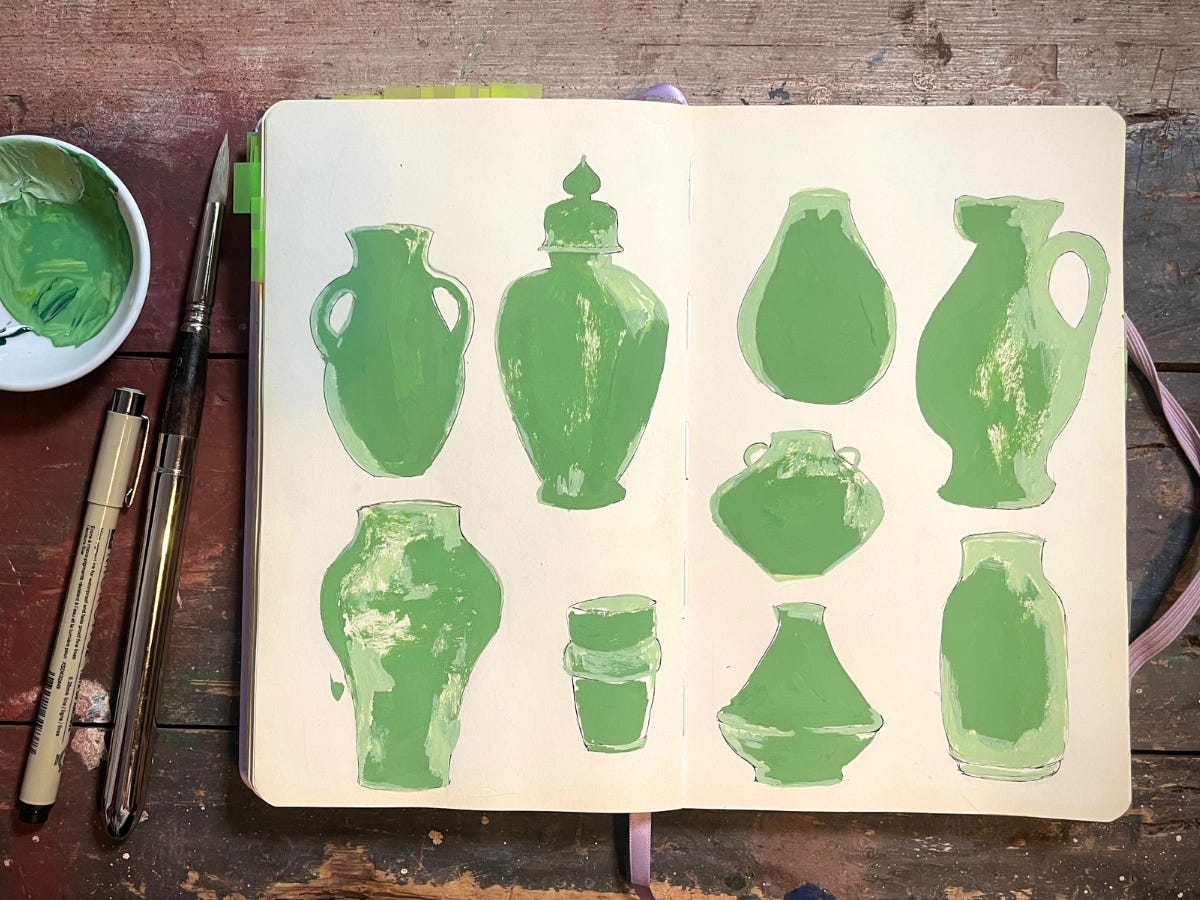
Day 17 unfolded exactly like that. This is Day 7 of my pottery + patterns theme — the first time I let form stand alone instead of reaching for decoration.
Nine shapes inspired by Moroccan ceramics slowly filled the page.
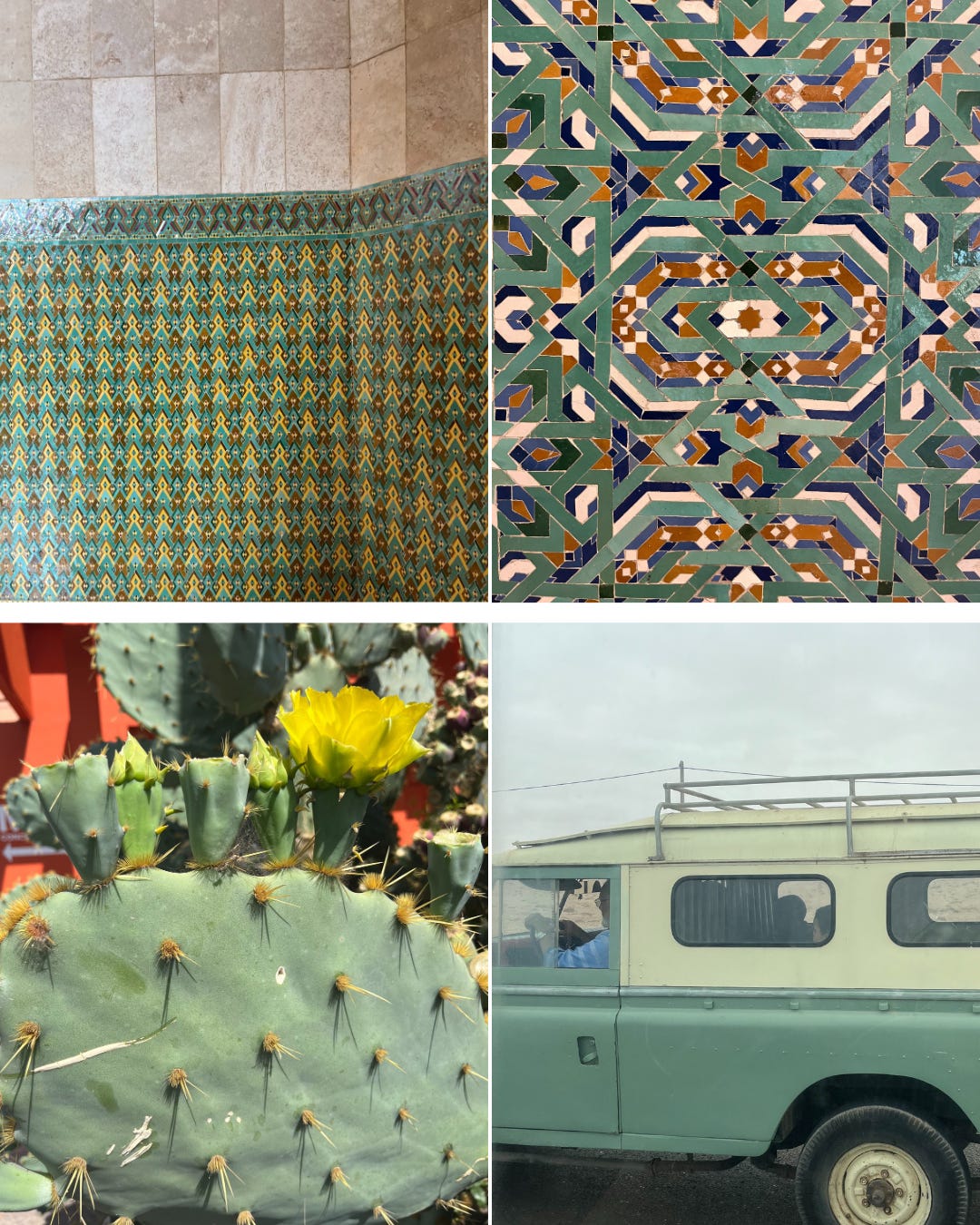
I scrolled back through my Morocco photos and quickly found the colour I wanted: a matcha green that felt both grounded and gentle.
The gouache painting came together quickly. The real work took place earlier—during the drawing, sketching, rubbing out, fixing, and pausing.
Without intending to, this page became a study of form. Of really looking, and looking again. Of staying with the shape long enough to understand it a little better.
You may have your own version of this — a cup on the desk, a bowl in the kitchen, something that looks “too simple” to worry about.
I was looking forward to adding patterns and details as always. Instead, I stepped away to take a break. That pause changed my mind. Coming back to it later, the simplicity felt right. There was no need to add anything else. The shapes didn’t need more; they needed space to breathe.
Your sketchbook has a page like that eager to explore the simplicity of shapes.
Studying shapes like this slows everything down. It sharpens the eye in a quiet way.
And it reminds me that simplicity can be a powerful place to stop, not a lack of effort, but a choice.